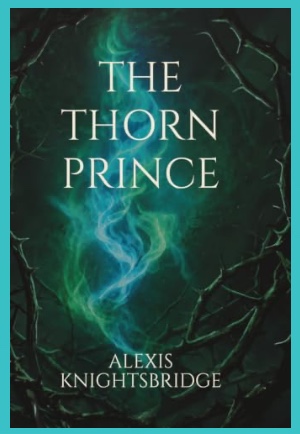
The Thorn Prince by Alexis Knightsbridge-review & interview
Amazon.com / Amazon.ca /
Don’t own a Kindle? Download the FREE Amazon Kindle App for your mobile device or pc
ABOUT THE BOOK: Release Date September 11, 2026
The Thorn Prince is not a quick read. It was never meant to be.This is a substantial, immersive adult fantasy novel built for readers who still want to disappear into a book rather than simply finish one.
The Thorn Prince was written as a novel in the old-fashioned sense of the word: a world large enough to become lost inside, characters given enough time to become real, and important moments allowed enough room to actually matter.
It begins in a London bookshop.
Thalia Lin trusts books more than people, has a fairly sensible life and absolutely no intention of becoming involved with wounded fae princes, living black thorns, ancient magic or doors between realms.
Unfortunately, the universe appears not to have consulted her.
When she finds Kael dying behind her bookshop, her blood does something it should not be able to do. The thorn binding him releases. An impossible bond forms between them. And the comfortable little world Thalia thought she understood begins opening into something much older, darker and considerably larger.
From London bookshops and hidden sanctuaries to dying realms, corrupted magic, war, horror, romance, grief, ridiculous amounts of tea and the increasingly inconvenient discovery that reality may be listening to Thalia more closely than anyone would like, The Thorn Prince refuses to stay inside a single genre.
It is fantasy. It is romance. It is thriller and horror. At times it is funny. At others it is deliberately uncomfortable. Beneath all of that, it is a story about trauma, freedom, belonging, choice and what remains of a person after something powerful has spent long enough telling them they have none.
And yes, it is long.
That is rather the point.
We live in an age increasingly fond of short, uniform chapters and stories engineered to move quickly from one beat to the next. There is nothing inherently wrong with that.
This simply is not one of those books.
••••••••
REVIEW:
The Thorn Prince opens in a London bookshop with a heroine who would rather stay among the shelves than risk the mess of other people.
Thalia’s quiet, book bound life collides with a dying fae prince bound in living black thorns, and what follows is a story of fantasy and a slow unravelling of everything she thought solid.
The bond that forms between them takes its time to form and the story takes its time letting that connection grow under the weight of trauma, distrust, and the gradual widening of the world beyond the shop.
The author has written something deliberately old fashioned in its scale (their words) looooong chapters that allow the book to breathe, (again their words) Do we need all the information? (my opinion is probably not, too many words to describe something simple)
I liked the mix of urban and dark magic. There is romance, bit again too many words and I did zone out a few times!
It is not always comfortable, and it is not always light, yet the humour and the ordinary details keep it from tipping into pure gloom.
At over six hundred pages this is a book that asks for patience. I almost DNF’d several times, but I did persist.
Would I recommend it? If you like your stories on the long/detailed side, then I’d say give it a go.
There seemed to be chapters inside the chapters 🤨 and again some of it didn’t really need saying.
I’m not sure if I’d read the second book, if it’s shorter than this, maybe I’d take a look.
Copy supplied for review
Reviewed by Julie B🦋

We would like to start with some background information. Would you please tell us something about yourself?
ALEXIS: So, my name is Alexis Knightsbridge, which is of course a pseudonym, or a writer’s name if you prefer, but there is an actual person underneath it!
I’m in my late twenties and I live and work in central London, in one of those big corporate buildings you probably walk past if you walk through the Square Mile. I’m actually from a very quiet village in the middle of nowhere. I came to London for university and just never left.
I suppose I had the traditional plan: school, university, good job. I did that. I genuinely love my job, but I write under a pseudonym because my work is client-facing and, after the amount of money I spent going to university, I can’t live on book income alone!
But I absolutely love books. I love romance, fantasy worlds, a little bit of horror and thriller, and books have always been somewhere I can disappear into.
One of my frustrations as a reader, particularly with romance written for women, was that I often couldn’t find myself in the female perspective. I don’t see myself as an object to be conquered, or a pornographic object there to play out somebody else’s fantasy. Even when women write for women, sometimes, not always, the gaze still feels wrong to me.
Yes, I want the male desire. I want to know that he wants her. But I also want the female internal voice saying, I actually desire this. I actually want him. I want this sensation. I want to do this.
And being confident in your own desire doesn’t mean you suddenly have to become some hyper-dominatrix with a whip and leather boots! You can just be a woman. You can feel, desire, seek, worry, laugh, want safety, want sex and mutually achieve whatever intimacy means between those two people.
Those are the books I wanted to read, so eventually they became the books I started trying to write.
I started The Thorn Prince probably three years ago thinking, like we all probably do at the beginning, I’ll write this and then fame and fortune will appear.
It turns out writing takes quite a long time!
While I was writing it, I stopped, learned, experimented and released some smaller books. Chasing the Horizon came first, then The Bodyguard’s Bargain, then Daydreamers, and now finally The Thorn Prince.
So although The Thorn Prince has only just been released, it was really where Alexis Knightsbridge started.
TRC: Who or what influenced your career in writing?
ALEXIS: As I said, I come from the middle of nowhere in the UK, and I’m probably a little bit rubbish at social media.
I always had a plan: school, university, good job. I did it. Then you arrive there and you have that slightly strange moment of, Oh. I’m here.
I love my job, but when you have spent years working towards a destination and finally arrive, books become both escapism and a bit of a reality check.
You always find that character who has reached where you have reached and is suddenly thinking, Is this me now for twenty years if I’m lucky, forty if I’m not?
I grew up loving C. S. Lewis and Roald Dahl, and as you get older and more curious you move through different kinds of books. Romance, fantasy, books like A Court of Thorns and Roses, Fourth Wing, From Blood and Ash, all these huge worlds people disappear into.
Escapism is wonderful, but fantasy also gives you that little dream while you are inside a book that maybe life can be bigger, stranger or more exciting than whatever you are doing on Monday morning.
But I still couldn’t always find myself in the books.
That was part of what pushed me towards writing.
The Thorn Prince was the first novel I started, even though other books came out before it. The problem was, once I began writing, suddenly everybody seemed to have a rule about how a book was supposed to look.
How long a chapter should be? How the text should be laid out? Where scenes should stop. How you were supposed to structure everything?
I studied literature and I’m an academic person by nature, and eventually I realised there were quite a few of those conventions I simply didn’t agree with.
So I sat with The Thorn Prince for about three years and used smaller books almost like practical exercises. I worked out which rules helped me and which ones made me sound less like myself.
Then around a year ago I started talking properly with Ethan Solace and Grace E. Sterling through what became SGK Author Collective.
We write at completely different ends of the spectrum, which is actually why it works.
Ethan talked to me about writing exercises and different ways of experiencing your own writing. Grace was very good at saying, essentially, define what your normal is and put something genuine into the world.
That brought me back to The Thorn Prince.
I write in blocks because that is how I naturally read and write academically. I don’t use first-line paragraph indents because I personally find blocks easier to read. I write very long chapters because I want a chapter to contain narrative light and darkness, action and reflection.
I realised eventually that I didn’t need The Thorn Prince to resemble somebody else’s idea of a novel.
It needed to be 100% mine.
TRC: What challenges or difficulties did you encounter writing and publishing your first novel?
ALEXIS: Probably the first challenge was the pseudonym.
Do I publish under my own name or put a wall between myself and the reader?
If I’m honest, it came down to my job.
University isn’t cheap, I’ve worked hard to build a professional reputation and I’m sitting in a boardroom trying to be the powerful woman I want to be. I don’t particularly want the immature man, or woman for that matter, sitting opposite me sniggering, Oh, she’s the woman who writes the sex books.
So that was the first big decision.
Alexis was the name of a childhood friend who, in my memory anyway, was strong, powerful and fearless. Knightsbridge is obviously a little nod to London and the places I now live around and visit, so it felt right.
Then there was actually making a novel.
The Thorn Prince has always been my first novel. It has just taken me three years to publish it.
I’m an academic in my work and life. I read academic books. I write academically. Even something as small as paragraphs not being indented matters to me because that is how I naturally process writing.
Then you discover covers.
You can spend years writing a book and somebody can decide whether they are interested in five seconds because of the front cover.
I had no idea what I was doing.
When I look back at Chasing the Horizon, I still love the story, but I struggled massively with the artwork. I fell into the generative-image trap at one stage and ultimately got rid of it because it annoyed me that I had spent all that time actually writing a book and then effectively pressed a button for part of its identity.
With help from Ethan and Grace I changed it and began learning proper digital construction, Adobe, Canva, CGI-style imagery and compositing.
The Bodyguard’s Bargain was going to become my cleaner indie style: strong block colours, professionally laid out in Canva.
Then I met the SGK lot properly and started learning more of the Adobe suite and how you can construct an image from elements, place them together, adjust them and composite them.
Daydreamers was really the first time I properly played with that. The central image is photography, worked and composited through Photoshop, then finished through Canva.
And The Thorn Prince cover has effectively been evolving with the book for three years.
Those earlier books prepared the road for the novel.
I learned how to publish, how to format, how to make mistakes, how to take criticism and hopefully how to grow a slightly thicker skin.
Then I released the book I actually wanted to read and hoped other people might love it too.
TRC: Would you please tell us something about the premise of THE THORN PRINCE?
ALEXIS: For me, The Thorn Prince is about people’s expectations and breaking them.
It is about finding the places where we are comfortable, exploring them, and then pushing at the boundaries.
I love bookshops, particularly old-fashioned bookshops that seem to have survived everything around them.
If you have been around London, York, Lincoln and places like that, you can walk into buildings that are hundreds of years old, sometimes much older, and you can almost feel the history around you.
So putting Thalia in an ancient London bookshop that has simply stood there while London and English history happened around it was important because I wanted the fantasy grounded in something believable.
And Thalia, by the way, is pronounced closer to “T’halia” in my head, even though I stubbornly spell it Thalia!
We start slowly.
She is a normal woman working and living in a London bookshop. Like all of us, she has layers, but on the surface she has friends, a job, routines, worries and a life.
I wanted the reader to know that reality before I started asking them to believe impossible things.
For me, magic isn’t the story. It is a thread inside the story.
Even things like travelling between realms were something I wanted to make as physically plausible as I could within a fantasy novel. Ethan gets some of the blame for that because we have had some very long conversations about physics!
The Thorn itself is also not simply “evil magic.”
For me it is about the possession of trauma, the way trauma spreads, infects and changes the things around it.
Kael is part of that personification too: trauma, survival, recovery, fear of your own power and, hopefully, enough desirability mixed in there to make the romance worthwhile.
The magical races were another thing I thought about.
If witches, fae, elves, pixies and everything else had been living beside one another for thousands of years, why would everybody still be some perfectly pure category?
Human beings don’t work like that.
People meet, relationships happen, families blend, cultures blend.
So the magical world reflects that.
The wider series is already called In the Beginning, and that title will become more and more relevant as the series develops.
Even The Thorn Prince as a title is slightly mischievous.
It encourages you to think the novel is about one thing.
Hopefully, somewhere along the way, you realise it is actually about something quite different.
TRC: Do you believe any of your characters in THE THORN PRINCE has/ have a fundamental flaw that may be questionable to the readers?
ALEXIS: I like this question because I think flaws are almost the point.
None of us are perfect or pristine.
We all know the magazine image is fake. We know the fairytale is idealistic.
So sometimes when we call something a character flaw, what we are actually talking about is a very normal trauma, worry, fear or insecurity.
This happened to me and I still struggle with it.
I worry that time is flying past and I need to do more with my life.
I wish my life was more exciting.
I want something and I’m frightened to reach for it.
These things are sometimes presented as though they are abnormal when they are so normal that most of us have probably felt some version of them.
When you give that to a character, the character becomes less fairytale and more human.
The reader can think, I could be that person.
Or, That person has my hopes and fears and look what they managed to achieve.
That is what I want from fiction.
I suppose the phrase I would use is fictional reality.
Everything around them can be fantastical, but the emotional person inside it should still feel real.
TRC: What kind of research/plotting did you do, and how long did you spend researching /plotting before beginning THE THORN PRINCE?
ALEXIS: I think The Thorn Prince and the wider series have been in my head for years.
Fantasy is probably what I most naturally love reading, and I have studied literature, although as I have said, I also eventually rejected quite a few of the standard conventions about how I was apparently supposed to write!
For the first novel, I had fixed points.
I knew where it started.
I knew roughly how they would reach Kael’s realm.
I knew what the Thorn was.
I knew Thalia’s abilities would develop, but I didn’t want to make her suddenly become the centre of the universe because she had discovered magic.
I wanted us almost to travel with her and discover Thalia during The Thorn Prince rather than be handed an instruction manual explaining who she is.
As for my sophisticated writing method, there are Post-it notes everywhere.
Notebooks.
Mind maps.
Chronologies.
Random bits of paper.
Things written down because I thought of them at stupid times.
Then there has been a ridiculous amount of writing and rewriting.
I also stopped and started the novel while writing three smaller romance books because I suppose I wanted to earn my stripes.
Those books let me work out the author I wanted to be.
And most recently SGK has been invaluable.
When you are an independent author and have sat with the same book for so long, you eventually stop seeing some of it.
You know what a sentence is supposed to say, so your brain starts reading the sentence you remember rather than the one actually sitting there.
Getting two experienced authors to read sections and say, This works, this doesn’t, you have overthought this, or go back and look at that again, was what eventually helped get it over the line.
TRC: Do you have plans for series? If so, will the series focus on the same character or a different couple with each instalment?
ALEXIS: Yes.
The series already has a name: In the Beginning.
There are some quite deliberate Easter eggs throughout The Thorn Prince about where the wider series is heading.
Thalia, Kael and Mara are going to remain central. I think that matters.
I don’t want to reach the end of this book and suddenly abandon everybody for a completely different couple.
Where The Thorn Prince ends, I have a very clear idea of where the next book begins.
In fact, I have already written the first chapter of Book Two and put some other ideas onto paper.
But my work life is crazy at the moment and we all have real-life things happening, so I am also letting myself sit with the book I have just released for a little while.
SGK has helped massively with that.
I’m rubbish at social media, if I’m honest, so sharing costs, ideas and some of the surrounding workload has given me much more space.
Although over the last month I appear to have taken over quite a lot of it, so Ethan and Grace may have a slightly different version of that answer!
TRC: How do you use the physical environment or the setting to heighten the tension and psychological intimacy in your story lines?
ALEXIS: I think it is everything.
What I’m trying to create in my books is something close to lived experience.
That applies to the settings, but it also applies to intimacy.
When I write explicit content, I’m not interested in pornographic make-believe or romance that tells women what they are supposed to want.
I have a very close group of friends and our conversations are broad. Of course women talk about men’s size, what we wore, all the silly things people pretend women don’t talk about.
But we also talk about the build-up.
The foreplay.
Did he actually fulfil what I wanted from the sex?
Did I feel safe?
Did I feel desired?
Did I desire him?
Did he somehow magically expect to know something I had never communicated?
He isn’t a mind reader.
And being sexually confident does not mean turning a woman into a cliché dominatrix.
She can simply know her body.
Know what turns her on.
Know what does not.
Know what sensations she wants.
So when I write intimacy, I don’t want performative sex. I want something that belongs to those characters in that moment.
In Chasing the Horizon, sometimes that is simply hot, steamy sex.
In The Bodyguard’s Bargain, sometimes intimacy is feeling empty and wanting to feel safe, held and whole.
In Daydreamers, intimacy can almost become magical.
And in The Thorn Prince, intimacy becomes one of the things that allows Thalia to get out of her own head.
The physical environment works exactly the same way.
Hart & Hemlock is safety to Thalia.
Book people understand that. I love the Bookstagram community even though I am terrible at the social-media part of it, and I don’t think it is a secret that lots of us feel most comfortable in a bookshop, hopefully one that serves coffee, with a brilliant book and a piece of cake or pastry.
So Thalia begins somewhere safe.
Then Kael arrives.
He is this powerful fae prince, but he is weakened and genuinely needs sanctuary. He needs Thalia.
He tries to be strong for her, but every time he does it costs him something.
Then London begins changing around them.
The Underground sequence was in my head long before I properly wrote it. Flickering Tube lights, the black windows becoming mirrors, the Thorn showing monsters through the reflections. I would ride the Tube thinking about it, which is probably completely normal behaviour!
Then their journey north takes them through the Lake District, through the fells and towards the lake and the Green Road. That landscape matters because parts of Britain already look like somebody invented them for a fantasy novel.
And separately, if you have ever been through the Scottish Highlands, I think they are about as close as the real world gets to simply looking like another realm.
Then the crossing itself becomes release, exploration, desire, power and control.
When they reach Kael’s world and the green begins spreading, the environment starts responding to recovery.
Touch, growing strength, life returning, but also fear of what your own power might mean.
Hopefully I got that balance right.
I think you can probably tell that although I wrote The Thorn Prince, I also absolutely love the thing.
TRC: World building in fantasy story lines can often be overwhelming to some readers. How did you develop your fantasy world without dropping too much information all at once?
ALEXIS: I think we have already touched on this because, for me, the emphasis is on lived experience.
And this is where I make a distinction in my own head between writing a book and writing a novel.
It is my philosophy, not some law everybody else has to follow.
For a more conventional book, I naturally tend towards chapters somewhere around five thousand words. Obviously that isn’t fixed. A chapter might be four thousand or seven thousand because the narrative should decide, not a calculator.
A novel, particularly a novel this size, is different for me.
I want the chapter itself to contain light and dark, action and reflection, movement and consequence.
That is why The Thorn Prince has eighteen proper, substantial chapters.
I have a real issue with the uniform roughly fifteen-hundred-word bell-curve chapter structure that I keep seeing in quickly generated books: same length, same rise, same turn, same little ending, then repeat fifty or a hundred times.
That isn’t how I wanted to write this.
When I begin, I write the full story without worrying too much about cutting it.
It becomes enormous.
Then I go back.
Rewrite.
Cut.
Move things.
Argue with it.
The reader needs enough room to sit inside the chapter and live in the narrative.
I want the story to feel sensory and immersive, almost as though either you have stepped into the book or the book has somehow started speaking directly to you.
If things happen too quickly and you do not care about the characters, why are you going to care about what happens to them?
So before I write, I know what structure I am working with.
If I am writing a shorter book, I understand that structure.
If I am writing a novel, I understand that I need much more space.
For me it is 100% about pacing.
And once again, making the fantasy feel real rather than feeling like somebody has stopped the story to explain the fantasy.
TGRC: Believability is an important factor in writing and reading story lines especially paranormal and fantasy. How do you keep the story line believable without sacrificing content?
ALEXIS: I think I have almost answered this already.
A fantasy shouldn’t feel like a fantasy.
It should feel real.
The reader should be thinking, I could see myself in that situation.
So you start with something they understand.
A woman working in a bookshop.
A friendship.
A job.
A Tube journey.
Wanting somebody.
Being frightened.
Feeling safe in one place and unsafe in another.
Then the fantasy elements are earned.
You aren’t simply saying, Here are seventeen things you need to know about my magic system before the story is allowed to start.
You let the reader believe one thing.
Then another.
Then another.
Eventually crossing into another realm doesn’t feel like you have suddenly changed books.
It feels like the next thing that happened.
That is what believable fantasy means to me.
TRC: Do you believe the cover image plays a deciding factor for many readers in the process of selecting a book or new series to read?
ALEXIS: Oh my God, yes.
And I’m going to be honest because I have been on a journey with this.
I’m incredibly grateful to Ethan and Grace because the original imagery I was working with around Chasing the Horizon was generative, and eventually I felt it cheapened the book and all the work I had put into writing it.
With their help I replaced it and moved towards proper digitally constructed, CGI/composite imagery.
And I do exactly what everybody else does.
I look at a book and sometimes think, That cover looks rubbish.
Or, That looks generated.
Or, That looks amazing.
We also live in a really strange time because you can pay thousands for professional illustration and that illustrator may be working inside professional software suites containing AI-driven tools anyway.
That is simply where professional creative software has gone.
There is also often a whole design process sitting between the author and the finished cover.
For an indie author, paying four or five thousand pounds for bespoke professional illustration on every title just is not realistic.
I have picked up books with generative covers and discovered that the book itself is phenomenal.
So I became much more interested in learning to do as much of it myself as I could.
The Bodyguard’s Bargain was going to become my new indie style: strong colour, clean design, Canva-made and professional.
Then Ethan and Grace started teaching me about Adobe, how images can be constructed from separate elements, how you place them, alter them, composite them and make them feel like one image.
With Daydreamers, the centre is photography that I worked through Photoshop and then finished through Canva.
And The Thorn Prince cover has had about three years of tweaks through Adobe and Canva alongside the book itself.
So yes, the cover is massively important.
And I don’t think readers always realise how bloody difficult it is to make a good one!
I hope I am starting to produce good covers.
But ultimately it is still me sitting there, learning, changing things, asking the collective what they think and occasionally losing an unreasonable amount of my life to one bit of lighting.
TRC: When writing a storyline, do the characters direct the writing or do you direct the characters?
ALEXIS: This is such a fascinating question and something we have all talked about inside SGK.
I think if I write and structure a shorter project from start to finish, like The Bodyguard’s Bargain, initially I am directing.
I make the mind maps.
I build the chronology.
I know where it starts and roughly where it needs to end.
But The Thorn Prince is a novel, and I lived with it for three years.
Three years is a long time to live with fictional people.
At some point, they develop personalities strongly enough that they start directing what is believable.
Mara is probably the best example.
Initially I wrote her as more of a reflective character who helped break up and bridge the narrative.
But she became so essential to the story.
As I got to know her through writing and then rewrites and edits, she became this strong, dynamic person with weakness, desire, fear, longing, humour and her own importance completely outside the job I originally gave her.
Eventually, if I wrote something that did not feel like Mara, Mara effectively rejected it.
And I think that happens even in the shorter books.
You direct them first.
But by the proofreading and editing stages, the character has become established enough that you start changing the writing to make them more themselves.
So maybe I direct them until they know who they are.
Then they start arguing back.
TRC: The mark of a good writer is to pull the reader into the storyline so that they experience the emotions along with the characters. What do you believe a writer must do to make this happen? Where do you believe writer’s fail in this endeavor?
ALEXIS: There is quite a lot I have already said about this, so I’m going to answer it from another direction.
I think one of the places books are currently failing is generative AI.
And when I say that, I need to be really clear about what I mean because everything with a computer in it is now apparently called AI.
I use Grammarly.
I use spellcheck.
Ethan is dyslexic and uses speech-to-text and text-to-speech software.
Those are tools that help an actual person write.
That is completely different, to me, from giving a generative system a prompt and asking it to produce the substantive book.
That is the distinction I care about.
Because I can see the results.
The roughly fifteen-hundred-word bell-curve chapters.
The extremely uniform chapter lengths.
Sentence lines everywhere.
Loads of one-line paragraphs.
Single words sitting dramatically on their own.
Repeated phrases.
Repeated emotional structures.
That is actually one of my pet peeves!
And for me it becomes wooden because there is no actual person living inside the book.
There is no personality behind the choices.
There is no author saying, No, I know that rule, but I want to break it here because this character needs another five pages to breathe.
The other problem is that if enough generative books flood the market, people begin getting used to what that structure looks like.
Then somebody opens a properly long novel, finds an eighteen-chapter structure where a chapter might be ten or twelve thousand words, and thinks, What on earth is this?
But maintaining a coherent chapter at that length is a writing skill.
You have to hold action and reflection, narrative movement, emotional consequence, light and darkness, and still know where the reader is inside it.
Generative systems, certainly the ones producing the mass-market rubbish I am talking about, are not doing that convincingly.
So where do writers fail to pull readers into emotion?
For me, it is when the writing stops feeling lived.
You can technically describe sadness without making me sad.
You can technically describe sex without making me feel desire.
You can technically describe danger without making my stomach tighten.
The human bit is the difference.
And I am absolutely pro-technology when technology helps the human being create.
I just don’t want to remove the human being and then pretend the product left behind is the same thing.
TRC: Do you listen to music while writing? If so, does the style of music influence the storyline direction? Characters?
ALEXIS: I do and I don’t.
Sometimes, particularly with some of the naughty scenes, music is really useful because those scenes still have to be narratively strong and properly structured.
They are still part of the story.
You can’t just arrive at page whatever and go, Right, apparently everybody is supposed to take their clothes off now.
Music can help hold the mood.
But one of the best habits I have actually picked up from Ethan is listening to my own text back once I have written it.
That is incredibly valuable.
It is how a reader is going to experience the flow of the writing.
If I have written and rewritten a chapter five or six times, it is incredibly easy to miss a mistake because I have convinced myself I know what that sentence says.
When you hear it spoken, you suddenly hear the problem.
Pacing.
Flow.
A word repeated too close together.
Punctuation that sounded perfectly sensible in your head and now sounds ridiculous.
Thank God for Grammarly as well!
Listening back has genuinely made proofreading and editing faster for me.
But yes, generally, I also just love music.
TRC: What do you believe is the biggest misconception people have about authors?
ALEXIS: I’m going to try very hard not to stand on a soapbox here.
Probably that somehow a book from a big traditional publisher is automatically more legitimate than an independently authored book.
That really bothers me.
The Thorn Prince took me about three years.
I wrote it.
Rewrote it.
Edited it.
Learned how to lay it out.
Learned how to make the cover.
Published it.
And then discovered the other one hundred and one jobs involved in trying to get anybody to notice that it exists.
I’m lucky now that SGK helps with some of that.
But the fingerprints are mine.
And I suppose that is where I think parts of the publishing industry have become slightly upside down.
Large commercial publishing can be incredibly formula-led.
There are market expectations, algorithmic ideas around what sells, expected lengths, expected structures and then layers of copywriting and editing where things can be removed or changed because they do not fit whatever version of the book the commercial process thinks it should become.
Sometimes I look at that process and think, At what point does the author’s strange little fingerprint start disappearing from their own book?
That is my issue.
Not that editing is bad.
God knows I need editing!
But there is a difference between helping somebody make their own work better and editing the shit out of something until the oddities that made it theirs have disappeared.
The same thing happens visually.
People can look at an indie cover and immediately decide it is somehow less legitimate because an author built it themselves.
Meanwhile a professional publisher might spend four or five thousand pounds on an illustrator or design team working in industry-standard professional software that itself contains AI and generative functionality, producing something to very carefully researched market expectations.
There might be several people involved, and the author may be a million miles away from the actual construction of that final cover.
That can produce incredible work.
I’m not denying that.
But why is that automatically considered more authentic than an indie author spending three years learning the tools and building their own?
The slightly wonky bit in an indie book might actually be evidence that a human being was there.
You might find the occasional spelling mistake or grammar slip in mine somewhere.
That is not me saying mistakes are wonderful and we should stop proofreading.
It is me saying The Thorn Prince was actually written by me.
I have not trimmed a chapter because an algorithm said the average reader stops paying attention after X thousand words.
I changed it because I thought it needed changing.
I kept things because I thought they belonged.
The cover exists because I spent years making it.
And then there is the other huge difference.
A successful contracted professional author may effectively be paid to write full-time, a bit like a professional footballer is paid to play football.
Independent authors like me are very often working full-time jobs and then becoming writer, editor, cover designer, formatter, marketer, administrator and social-media department afterwards.
So I suppose the misconception is that “independent” means less legitimate.
For me it often means the opposite thing creatively.
It means the author’s fingerprints are absolutely everywhere.
TRC: What is something that few, if anyone, know about you?
ALEXIS: Probably that I really don’t know what I’m doing.
And I think that is something most of us rarely say out loud.
We are making quite a lot of life up as we go along.
You can have the degree.
The career.
The job.
The plan.
You can apparently look like a functioning adult from the outside.
And internally you are still going, Right. I suppose this is what we’re doing now.
So I’m just a normal person trying to muddle through life and, hopefully, live a good one.
TRC: On what are you currently working?
ALEXIS: This connects to a couple of the other questions because I have spent about three years writing The Thorn Prince and released the smaller books around it partly to sharpen my writing skills.
So currently, honestly, I’m trying to focus on work!
But I have written the first chapter of Book Two of The Thorn Prince, so I know precisely where the story goes when I proverbially pick the pen back up.
I also feel like I really found my author feet with Daydreamers, so I want to write Book Two of that.
And I have a more daring romance sitting in my head as well.
Something perhaps along the lines of Expand Your Horizon, but written now that I hopefully know much more about what I’m doing.
Something that speaks very directly about female desire.
I tend to write in spurts.
I get a couple of weeks off here or there and I’ll either disappear into reading or write the bones of a book.
Then I might finish it over the next few months.
Or, apparently, I spend three years writing one enormous novel while writing several other books around it to make sure the enormous novel becomes as good as I can make it!
TRC: Would you like to add anything else?
ALEXIS: Mostly just thank you.
Thank you for taking the time to send me the interview and for giving independent authors like me the room to talk about our books and also about the industry around them.
I would also like to thank SGK for giving me the occasional kick up the bum to actually do things.
Sharing some of the jobs, expenses, feedback and general chaos has given me time and space to do this.
And obviously it is nice that people are buying my books.
It is amazing that I can make money doing something I genuinely love.
But that actually isn’t the bit that makes me happiest.
The thing that makes this worthwhile is somebody messaging me and saying, I really loved that story.
I know not everybody is going to love my books.
That is just part of being an author.
But when somebody sends me an inside joke from the book, or says, Please make some tea, or tells me I have made them desperately want an almond croissant, that means something completely different.
Because then I know they were actually there.
They didn’t just read the big scenes.
They sat inside the little ones.
They noticed the tea.
The pastry.
The quiet conversations.
The moments between the action.
Really, I’m making the books I want to read.
The fact that other people are reading them, living in them for a little while and enjoying them too is the bit that still feels slightly unbelievable.
So I just hope I can keep doing this for a while and that people continue enjoying what I make.
And genuinely, thank you for taking the time to give me the space to talk about it.
LIGHTNING ROUND
Favorite Food
Thai or Asian fusion.
Favorite Dessert
Traditional apple crumble.
It reminds me of school, which is probably half the reason I love it.
Favorite TV Show
The Big Bang Theory, Taskmaster, anything funny and easy watching really.
Last Movie You Saw
Oh God, this is where I’m probably supposed to say something romantic.
It was actually Spider-Man: Brand New Day.
Dark or Milk Chocolate
Both.
I love assorted Lindor because then you get a mixture and I don’t have to make that decision!
Secret Celebrity Crush
Keira Knightley in Love Actually.
Or Hugh Grant in Notting Hill.
Apparently there is a very specific British-rom-com era involved here.
Last Vacation Destination
Turkey.
Do you have any pets?
I used to have loads growing up. Cats, dogs, fish.
Now I live on my own and apparently can’t even keep plants alive, so no!
Last book you read
Book Two of The Awakening series by Grace E. Sterling, which isn’t even released yet.
And wow.
I genuinely cannot wait for people to read it.
I think it is going to be massive.
TRC: Thank you Alexis for taking the time to answer our questions. Congratulations on the release of THE THORN PRINCE. We wish you all the best.