The Solarian Deep (Technoquatics 1) by David Deane Haskell-review & interview
Amazon.com / Amazon.ca / Amazon.uk / Amazon.au /
Don’t own a Kindle? Download the FREE Amazon Kindle App for your mobile device or pc
ABOUT THE BOOK: Release Date February 22, 2026
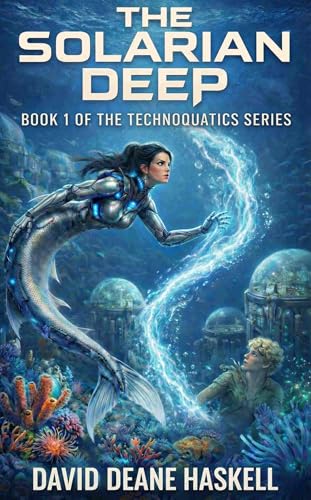
Humanity didn’t flee to the ocean. It was built for it.
Calistya is a groundwalker — half-adapted, half-committed, priced out of the Full-Gill Enhancement that would make her whole. No gear, no limits, no more being told she swims like she doesn’t belong. Just the open ocean, endless and free.
She can’t afford it. She’s an orphan. That’s just life.
Until the day she dives too close to The Deep.
Below the city’s light, at the edge of the abyss where sentinels don’t go, she sees a boy. No oxygen rig. No surgical scars. No implants. Just skin, and something about him that shouldn’t be possible.
He shouldn’t exist.
He looks at her once. Then he’s gone.
When her best friend Khrystal vanishes into the abyss chasing the same impossible truth, Calistya faces a choice: stay safe inside a city that was never quite home — or dive deeper than her gear was ever designed to reach.
Down in the dark, she’ll discover that evolution didn’t wait for surgery.
And whatever came first is still down there. Watching.
•••••
REIVEW:THE SOLARIAN DEEP is the first instalment in David Deane Haskell’s young adult TECHNOQUATICS sci-fi, post apocalyptic series.
Told from several omniscient third person perspectives THE SOLARIAN DEEP follows three ‘friends’ as their pathways take each in a different direction. Years earlier, a disaster left most of the world submerged under water, and those who endured had been forced to change in an effort to survive. Merfolk, genetically and bio-engineered to subsist under water, led to the possible sighting of a real, biological merboy, and in this, The Deep and its’ dangerous waters, had been deemed off -limits. Khrystal and Calistya were orphans, raised and schooled by headmasters and teachers at the Orphan’s Collective Institute for Girls but both wanted something different, and their desire to explore, threatened the peace and survival of everyone involved. Wnen Calistya and Khrystal go missing, presumed to have ventured beyond The Deep, a hunt threatens any chance at peace with a civilization thought not to exist.
The world building focuses on two civilizations struggling to survive. Humans, having survived an apocalypse, continue to claim both water and land as their own but in doing so, threaten the creatures and the eco-systems that make up the planet. Humans are greedy yet inquisitive, feeling threatened by the unknown, and in their quest for knowledge and power, destroy that which they don’t understand. Both an evolution and revolution are on the horizon-‘change is a threat’
There is a large ensemble cast of interesting and desperate secondary and supporting characters including a civilization of mer-people battling to survive in the wake of threats by their human counterparts. A mayor desperate for control, takes aim at what she does not understand, declaring war in her fight for power, and a young merboy named Kyle, may be the catalyst
THE SOLARIAN DEEP is an easy read, focusing on the unknown, and humanity’s need to take what doesn’t belong. The character driven premise is uncomplicated yet dramatic-a story directed at a younger audience; the characters are aggressive, and determined. Like most young adult story lines, the requisite troubling and controlling adults threaten the lives of the mer-people and humanity; the lead characters, although young and inexperienced, will become the saviors, keeping stability where chaos ensues.
Copy supplied for review
Reviewed by Sandy

TRC: Hi David and welcome to The Reading Café. Congratulations on the release of THE SOLARIAN DEEP
We would like to start with some background information. Would you please tell us something about yourself?
Social Media: Goodreads / Website/ Amazon Author /
David: Sure thing. My name’s David Deane Haskell, I’m from the Boston area originally but I’ve lived in Asia (mostly Japan) for the past twenty-five years. I’m a professional musician and music teacher among other things, and I played drums on trash cans at Tokyo Disneyland for a good many years back in the day.
These days I’m mostly devoted to my writing career, fiction and non-fiction, and that aside I spend a lot of time with friends in Tokyo, and cycling along Tokyo Bay and spending as much time in nature as I can.
I have one child, a 22 year old daughter, and she’s awesome. She lives with her mom not too far from here and I absolutely love spending time with her. She’s also my favorite travel buddy.
TRC: Who or what influenced your career in writing?
David: My writing journey started in a real way in college, when I took a creative writing class. Before that, I always thought that writing was all about the rules, never really imagining that I could write fiction. I figured that was for special, highly trained “novelists.” Instead, I played music, and that was my creative outlet. But I loved books and movies, especially sci-fi. I just never thought that I could tell my own stories.
That creative writing class was very free and open, the teacher a really chill grad student. He was open to whatever creative ideas we might come up with. And I just started writing what I felt like, and sort of aimed to shock the class when it came time to share. I wrote for reaction, which was the first time I did so, and I did get some really interesting feedback. Not everyone in the class liked it, but some did.
And that was the spark.
Then I didn’t really do much for a while. Publishing seemed beyond daunting. You had to go through all the gatekeepers and face rejection at every turn, all that unappealing nonsense. But the Kindle explosion happened in the early 2010s, and I decided to get in on it, not really thinking that it would become the life passion it has for me.
I published my first full-length novel in 2013, Too Much Information, and three more in short order. Emergence was the last of that early stage, published in 2019.
By then I was going through a lot emotionally and spiritually, contending with trauma and addiction issues which were threatening to ruin my life. That caused a five-year writer’s block from 2019 to 2024. I couldn’t write a thing worth keeping, couldn’t really tell you why, and wondered constantly whether I should just give up.
But I couldn’t.
Finally, right around the new year in 2024, the block ended. Just like when I was blocked, I couldn’t tell you why I wasn’t anymore. I just wasn’t. And I started writing more than ever before. It really was pouring out of me, fiction and nonfiction. Wasn’t how I planned it, but it was a new phase of my career in almost every way.
Since that time I’ve published two books. The Solarian Deep, a first-contact sci-fi about transformation and societal upheaval, set in a post-apocalyptic undersea society known as ‘Technoquatics’. I also published Wounded Angels: A Memoir That Lights the Path to Your Own Inner Child Healing. This is a real-time record of the emotional and spiritual healing work I was in the thick of in the summer of 2024, written as it happened.
TRC: What challenges or difficulties did you encounter writing and publishing this series?
David: Well, it started as a serialized novel online, and so the biggest challenge creatively was in coming up with the “what’s next”, as a story I started without knowing the ending, or even how long it would take to get there. It wasn’t a series at first, just a standalone, but along the way I realized the ideas were getting bigger than one book could contain, so the story that far became The Solarian Deep, and the general series became The Technoquatics.
TRC: Would you please tell us something about the premise of THE SOLARIAN DEEP?
David: A story of misfits trying to force themselves to fit in. A transformation story. A first contact of sorts, and a story about human evolution set in a post-apocalyptic society under the sea, forced into their circumstances when the surface became unlivable.
TRC: What kind of research/plotting did you do, and how long did you spend researching /plotting before beginning the series?
David: None lol..I mean, when I write something technological I’ll occasionally do a bit of googling (for this one I researched how scuba gear worked a few times, though this is far future and nearly fantasy in some ways..so I took a lot of liberties.
TRC: How many books do you have planned for the TECHNOQUATICS SERIES series?
David: At the moment, three. But as I mentioned, it was a stand alone in the beginning, so if the world keeps expanding and evolution keeps going in wild directions, it might be more than that.
TRC: Would you label the THE SOLARIAN DEEP series Paranormal? Sci-fiction? Or a combination?
David: Science fiction, in the sense that I think everything in the lore is plausible in a tech sense, though there is a bit of ‘magic’ in there, or so it seems, which isn’t really the run-of-the-mill science experiment..so yeah, it could be paranormal now that I think about it.
I’d love to hear what the readers think about that! Particularly about the nature of the Solarians.
TRC: Do you believe science fiction authors and promoters/ publishers do not do enough to attract female readers ? female writers?
David: Yes, I think so. I thought straight back to Star Wars and their “only woman in the galaxy” issue lol..though I think these days some mainstream storytellers might try to force characters in just to check the box. I don’t really do that myself but somehow The Solarian Deep would up with I think a pretty equal balance of characters. Two of the three main characters are female, and a number of the key figures beyond that as well, including a rather disturbing antagonist as well. So that just sort of played itself out as the story unfolded in my head, and if that means the story is more relatable to female readers I am absolutely thrilled about that. And in terms of transition, too, I also feel that The Solarian Deep addresses some of the more profound LGBTQ issues, without being direct about it. Again, I’d like to know if the readers think so or not..because I wasn’t trying to be subtle per se but it just unfolded the way it did naturally, and later I looked back and thought ‘yeah, this might be a trans-folk sort of story, in a technological and evolutionary wrapper.
TRC: What do you believe is the best way to attract female readers to Science Fiction?
David: As above, I think having relatable female characters who make sense and come of as genuine is the key. Not necessarily a mirror image of what is typically a male character, but just a regular female character in a compelling story just like we hear about in real life every day.
TRC: Believability is an important factor in writing story lines especially stories of fantasy and science fiction. How do you keep the story line believable? Where do you think some author’s fail?
David: Well, I do think there are no rules. And I don’t know if I always manage to keep everything believable or not. But as a scifi writer I don’t really go far-future too much (The Solarian Deep is an exception, but mainly because the setting had to make sense, plus being an evolutionary story there had to be time enough for those transitions to make sense..but still if not for those factors I think it could be set fairly close to now, a hundred or two hundred years forward maybe). I write near-future stories, mostly. AI and human achievement stuff. And also technothrillers which could be modern day or just slightly into the future. Hopefully all that is believable, but at the risk of being ridiculously repetitive, I do leave that up to the readers, as well.
TRC: Do you believe the cover image plays a deciding factor for many readers in the process of selecting a book or new series to read?
David: I’m sure it does. That’s a real Achilles heel for me though. I don’t have a good eye for art, and the stuff I find compelling rarely matches the mainstream. So I’m struggling with that and trying to learn as much as I can.
TRC: When writing a storyline, do the characters direct the writing or do you direct the characters?
David: They tell me what they’re going to do, and then I try and make the surroundings fit as best I can.
TRC: The mark of a good writer is to pull the reader into the storyline so that they experience the emotions along with the characters. What do you believe a writer must do to make this happen? Where do you believe writer’s fail in this endeavor?
David: I don’t really believe there is such a thing as a “good” writer or a bad one. Some of the worst writing, technically speaking, is highly popular. And some really amazing writing remains obscure. So, I think we write from the heart and let the chips fall where they may. I don’t spend a lot of time worrying about it, but I do feel that my characters feel things, deeply, and it’s a struggle to do that justice with the way I narrate their experiences.
TRC: Do you listen to music while writing? If so, does the style of music influence the storyline direction? Characters?
David: Nope. Can’t. I get pulled into the music too much. The only music I can listen to is ADHD focus music (that works like a charm! I can really concentrate better with that, so I put it on when I have a lot of work to do.
TRC: What do you believe is the biggest misconception people have about authors?
David: That they have tons of ideas and other people can’t do the same. I think everyone has a million story ideas and concepts within them. It’s just a matter of relaxing into it and then,if you want, writing them out. I mean, we dream, right? Think of all the different wild things that happen in our dreams. Everyone is creative. So everyone could be a storyteller too, if they didn’t limit themselves. I used to wonder if I was a “creative person” or not, but I learned over time (and wrote about it in my non-fiction) that that was self-image and trauma talking. I’m plenty creative, and so aren’t many of the fine authors I’ve met who sound somewhat down on themselves when you ask them how the work is going.
TRC: What is something that few, if anyone, know about you?
David: I love to dance. I do it on the beach, when nobody is looking. And someday, if I feel confident, I might even do it in front of people.
But probably not.
TRC: On what are you currently working?
David: I have a fiction story in the works, The Vibrants, and a stand-alone short story that goes along with it is available for free on my website. Tommytune is the name of that, and this story goes straight to the heart of creativity, technology, and what it means to be human.
I am also writing a non-fiction inner child healing book entitled Inner Child Unleashed. This chronicles my experiences with inner child healing and trauma recovery, and is the follow-up to my first inner child book, Wounded Angels.
TRC: Would you like to add anything else?
David: Just that I am so grateful for this opportunity, and I hope to hear from folks who’ve read this interview and/or my books and get feedback on what you think. Thank you all so much for reading, and to everyone at The Reading Café for hosting these in-depth interviews!
LIGHTNING ROUND
Favorite Food – Mom’s Italian ravioli sausage and gravy.
Favorite Dessert – Häagen-Dazs
Favorite TV Show – The Sopranos
Favorite Sport – cycling (to participate), basketball (to watch)
Last Movie You Saw – The Mandalorian and Grogu
Dark or Milk Chocolate – Dark
Secret Celebrity Crush – Timothy Chalamet
Last Vacation Destination – Thailand
Do you have any pets? No. I’d love to have a dog though!
Last book you read – The Three Body Problem.
TRC: Thank you David for taking the time to answer our questions. Congratulations on the release of THE SOLARIAN DEEP.